
Update to The Rugbyology Activity Classification System
If a model is to remain useful, it must remain open to revision. By that standard, the past 12 months have been among the most productive in the history of the Rugbyology Activity Classification System.
Nearly a decade since its inception, the Rugbyology Model remains responsive to emerging knowledge and ongoing experience. Rather than offering a final answer, it evolves in response to the irreducible uncertainty of the environment it seeks to navigate. Though the model has long been shaped by contemplation, reflection, and revision behind the scenes, this update is now ready for public release.
What follows should be read as a summary of the principal revisions rather than a complete exposition of RACS 2.5. A more comprehensive treatment of the framework as a whole will follow in due course.
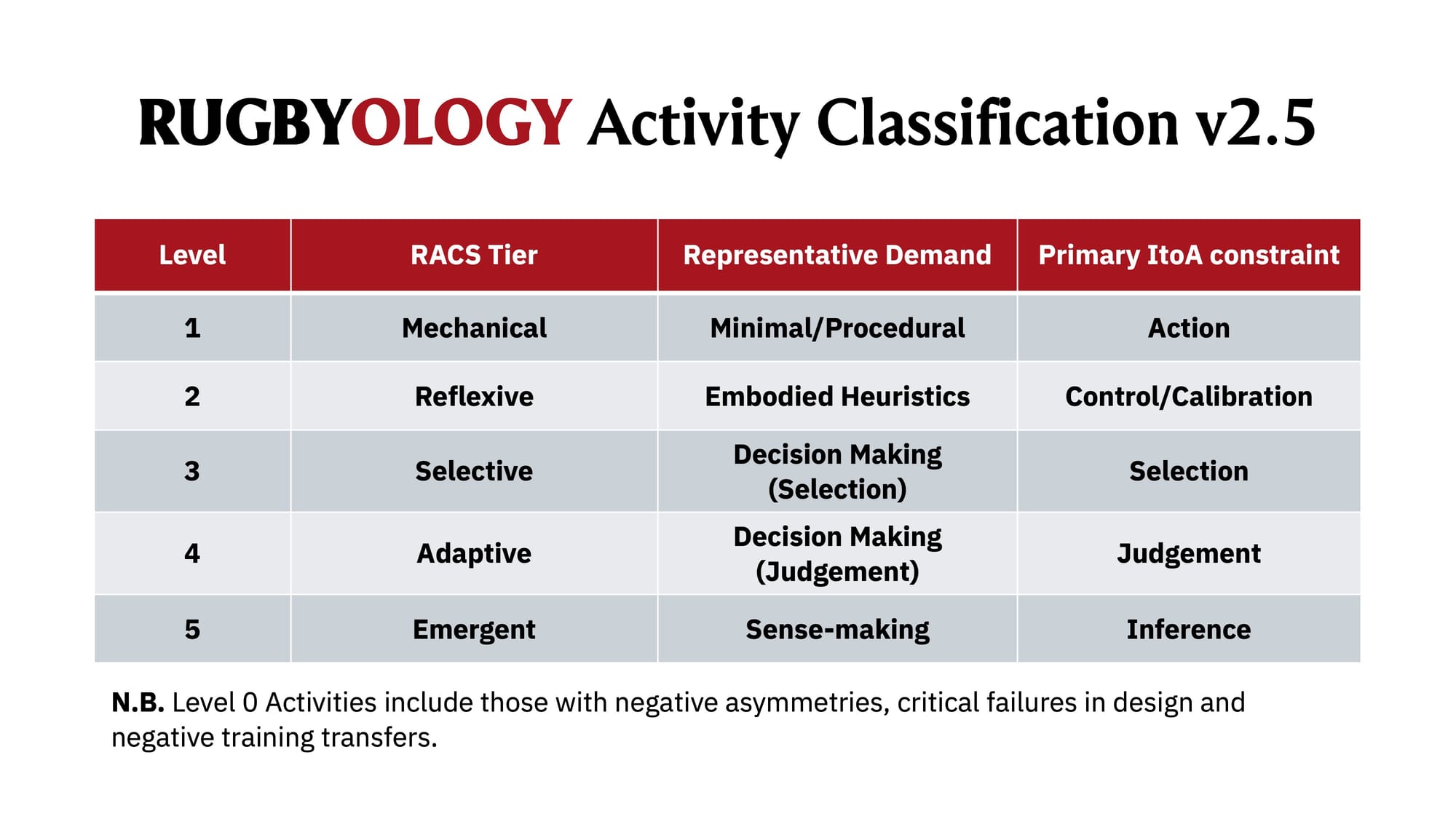
In practical terms, RACS 2.0 renamed the tiers and replaced the original classification matrix with the Representative Cognition Model, while RACS 2.5 extends that revision by adding a fifth tier.
The RACS 2.0 Update
The original version of RACS contained three limitations that became increasingly difficult to ignore.
First, aspects of the terminology, particularly the use of the term complex, lacked precision and invited interpretations that did not align with the intended meaning of the model.
Second, the criteria-referenced matrix created too much overlap between tiers, making classification less clear and more subjective than it should have been. Given that one of the central purposes of the system was to make classification more usable, this ambiguity undermined one of its primary functions.
Third, the system underrepresented preparatory rugby activities, with many mechanically simple but superficially “rugby-specific” drills being elevated into higher tiers without sufficient justification.
The RACS 2.0 revision centred on two fundamental changes: the renaming of the tiers and the replacement of the original classification matrix with the Representative Cognition Model.
Introduction of the Numerical Classification System
When I first introduced the numerical classification system, it was almost an afterthought. The aim was simply to provide coaches with a cleaner shorthand, allowing them to communicate more efficiently without having to navigate some of the more cumbersome tier names.
What I did not anticipate was how quickly the numerical system would become my default. If I am being completely honest, I barely think in terms of the tier names anymore. I think almost entirely in terms of levels. I know what makes something a Level 1 activity, and I know what makes something a Level 4 activity.
What began as a modest gain in efficiency may, in practice, have improved the model’s effectiveness. At the very least, it has become the clearest and most natural way for me to think about and communicate the tiers.
Renaming of the Tiers
While the numerical system has become my preferred shorthand in practice, the tier names still matter because they express the underlying conceptual distinctions of the framework.
Far from being cosmetic, this revision addresses a longstanding problem of conceptual clarity. The original terminology, especially complex, had become increasingly inadequate, inviting interpretations that did not align with the distinctions the framework was intended to capture.
These new names are inseparable from the revised classification approach that follows. They mark a change not only in nomenclature, but in the conceptual logic of the framework itself.
| Old Terminology | New Terminology |
|---|---|
| Preparatory | Mechanical |
| Developmental | Reflexive |
| Complex | Emergent |
| Competitive | Adaptive |
Introduction of the Representative Cognition Model
The original Rugbyology Activity Classification System employed a criteria-referenced classification matrix to determine an activity's placement within the hierarchical framework.
This comprehensive approach drew from diverse fields including sports science, psychology, pedagogy, decision-making theory, complexity science among others and incorporated factors such as cognitive load, environmental variability, skill transfer potential, decision-making complexity, and temporal constraints.
As I've previously mentioned, there were issues with overlap. Certain activities would clearly fall within multiple categories.
They might have had 4 out of the 5 criteria in one category and then 4 out of 5 of the criteria in another category, making it much messier than it needed to be.
Resolving this criteria problem has been my primary focus for several years.
The Representative Cognition Model
The Representative Cognition Model replaces the complicated criteria-referenced classification matrix with one simple question:
What is the cognitive load of the activity?
This single question eliminates the need for a more cumbersome matrix because the cognitive load of an activity is itself a function of the essential criteria the previous model was attempting to capture.
When coaches begin by identifying the target cognitive level, it creates a clear pathway for designing more purposeful and effective practice activities.
Classifying Cognitive Load
Just as there were four tiers in the RACS, there are four corresponding cognitive tiers.
These tiers are:
- Mechanical - No Cognitive Load/Procedural Cognition
- Reflexive/Developmental - Embodied Heuristics
- Emergent - Ecological Rationality/Decision-making
- Adaptive/Competitive - Sense-making
I will go deeper into these definitions at a later date for those who are unaware, but this was the single biggest change to the RACS model in a decade. In a rare display of lucidity, these revisions have rendered the model not only simpler, but also more robust.
This method of classification also solved the third major issue of the underrepresentation preparatory rugby activities.
Taken together, these changes made RACS 2.0 clearer in theory and more usable in practice. The renaming of the tiers improved conceptual precision, while the Representative Cognition Model simplified classification and provided a more coherent way of accounting for activities that had previously sat awkwardly within the framework. In many respects, however, RACS 2.0 also set the stage for the next revision.
The RACS 2.5 Update
After completing the 2.0 update, I assumed the framework would remain settled for at least a little while.
That assumption did not last long.
The more I observed a wide range of activities from across the coaching world, the more obvious it became that something was missing from the model.
What was missing was a fifth tier. Much of what coaches describe as decision-making does not involve the kind of ecologically rational judgement associated with more open and genuinely emergent environments. These activities are often constrained to the point where the athlete is not so much judging under uncertainty as selecting within a narrow and pre-shaped range of possibilities.
Once that distinction became clear, so too did the need for an additional tier.
The Missing Tier
The addition of a fifth tier makes explicit a distinction that had previously remained compressed within Tier 3. What had once appeared to be a single category in fact contained two qualitatively different forms of decision-making.
I first approached this distinction through the language of choice and judgement. That framing still captures the intuition reasonably well. However, I now regard the more precise formulation as one of enabling constraints.
Under the revised framework, Tier 3 describes action shaped by a single dominant context-specific enabling constraint. Tier 4 describes action shaped by multiple interacting context-specific enabling constraints. In simpler terms, Tier 3 narrows action around one salient organising feature, whereas Tier 4 involves behaviour emerging from the interaction of several such features at once.
The new tier therefore does not simply add another level to the model. It clarifies a distinction that was already present, but previously under-theorised.
RACS 2.5 should not be understood as a departure from the earlier revision so much as a continuation of it. The addition of the fifth tier does not overturn the logic of the framework, but sharpens it by making explicit a distinction that had previously remained compressed within the model.
As with the earlier revisions, the objective has not been change for its own sake, but greater clarity, greater usability, and a more faithful account of the environments coaches are actually trying to create. A more comprehensive treatment of the framework will follow in due course.
No spam, no sharing to third party. Only you and me.